| MSC206 |
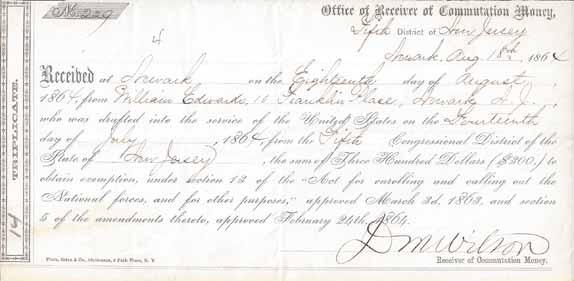
Union Document - Commutation Money Receipt - Printed
filled-in receipt for $300 from William Edwards of Newark NJ to obtain
exemption from the conscription laws. William Edwards was drafted July
14, 1864 and the receipt is dated "Aug 18th 1864" more than a month
after he was drafted. This is Receipt #229 with imprint "Office of Receiver of Commutation Money" signed
by D. M. Wilson Receiver of Commutation Money. When a young man was
drafted into the Union Army, he had several choices: 1) He could enlist
and report for service in the army as required by the draft, 2) or he
could hire and pay for a substitute to take his place, 3) or he could
buy his way out of the draft for the sum of $300 paid to the Federal
government. This was according to the conscription law passed in March
1863. Only the rich could afford to hire a substitute or pay the $300
to avoid the draft. $300 represented a year's salary earned by an
ordinary worker in the 1860's. So the poor working man was drafted and
went to war while the rich legally bought their way out of going to
war. This was one of the causes of the bloody New York City Draft Riot
in July 1863. Not many of these commutation receipts remain as people
grew ashamed later of paying money to stay out of the war and did not
keep the receipts. When one of these rare receipts came up for sale in
the recent past, it would sell at auction for as much as a $1000 or
more. Fairly recently, a small hoard of these receipts was found in
Newark NJ (known as the "New Jersey Hoard") consisting of perhaps 50
examples making them a little more readily available to the collector.
This receipt is from that newly discovered hoard. An interesting item
of Union Civil War history. Minor edge fault at upper left and several
light vertical file folds.
Alfred Edwards, who resided at 10
Franklin Place in Newark NJ (address is on the receipt), according to
the 1864 Newark City Directory is listed on the 1860 Federal census as
51 years old and a "Silver Plater" by profession with a real estate and
personal wealth of $30,000 ($1,100,000 in today's money). His son
William was 21 years old in 1864, and Alfred could easily have afforded
to buy his son out of military service according to the law of the
time. |
$250.00 |
 JLKCSA@aol.com
 -- Confederate Order
Form --
-- Confederate Order
Form --